Description:
Glioblastoma is the most aggressive primary brain tumor, with a median survival of 15 months after diagnosis (PMID: 34185076) despite treatment combining surgery, radiotherapy and chemotherapy (PMID: 15758009). Recurrence occurs in almost all patients within a median of 10 months. These systematic therapeutic failures are due to treatment-resistant cancer stem cells, a highly immunosuppressive microenvironment and research models that are too far from clinical reality.
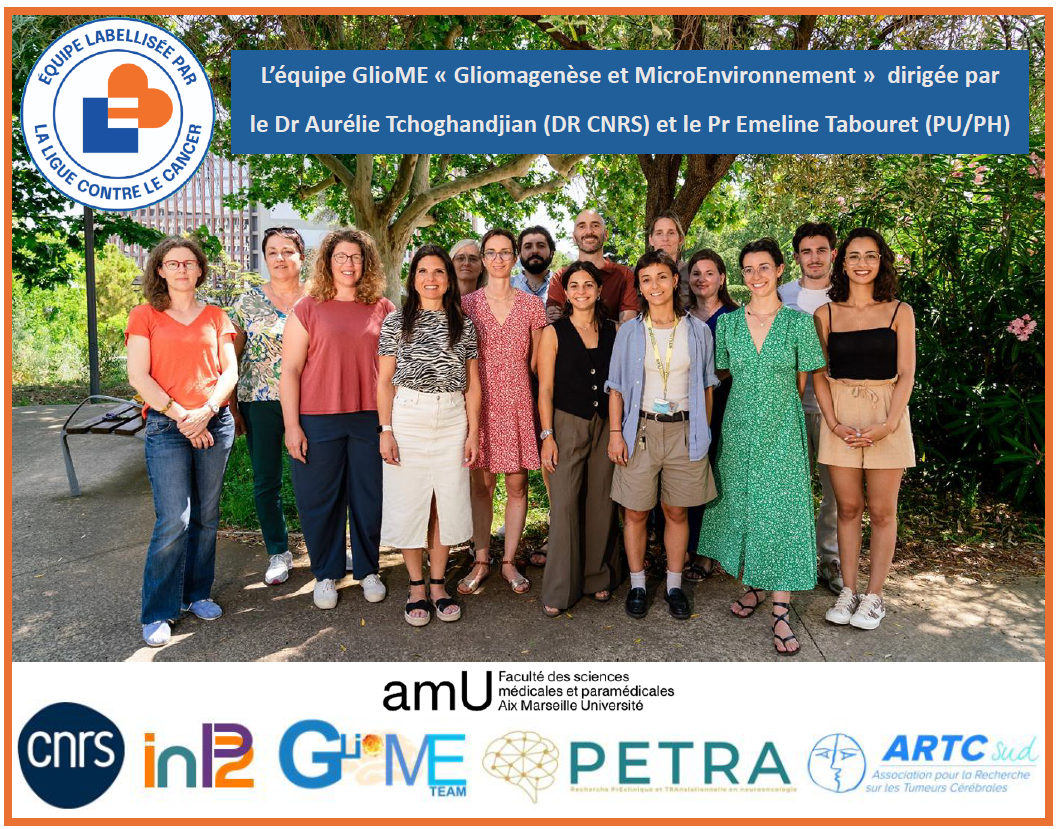
Our GlioME team aims to address these challenges through a basic-translational-clinical research continuum.
Our team has identified the GD3 ganglioside as a marker of cancer stem cells and ML-IAP as a major player in immunosuppression. We are developing new complementary therapeutic approaches, directed against these targets, as well as local treatments allowing direct delivery of new therapies at the brain level, in order to bypass the blood-brain barrier, the main obstacle to the effectiveness of glioblastoma therapies.
At the same time, we are generating relevant preclinical models of glioblastoma to evaluate therapeutic approaches, through the development of tumor avatars derived from patient samples (PMID: 39252580), or or more complex and integrated mouse models (PMID: 42741395).
The strength of our team lies in our multidisciplinary expertise, an optimal environment with the proximity of clinical departments and technological platforms, and a strong collaborative network, creating a favorable ecosystem for advancing GBM therapies toward early-phase clinical trials.
Public Summary:
Glioblastoma is the most aggressive type of brain tumor. Despite undergoing surgery, radiation, and chemotherapy, most patients see the tumor relapse within 10 months, and the average survival time is only about 15 months after diagnosis. This poor outcome is due to several factors: some tumor cells (called cancer stem cells) are especially resistant to conventional treatment driving recurrences, the tumor environment in the brain suppresses the action of the immune system, and the research models used to study glioblastoma in most laboratories don’t fully reflect how the disease really behaves in patients.
Our research team, GlioME, is working to develop new and more effective treatment strategies. We have discovered two promising targets in glioblastoma, called ML-IAP and GD3, to target cancer stem cells and tumor microenvironment, that could be attacked with specific therapies. We’ve also built advanced lab models of brain tumors to be used in preclinical phases, including tumor avatars and tools to study what happens in the brain after surgery.
Research topics:
Background
Our team showed that cells with cancer stem cell (CSC) properties were identifiable in human glioblastoma (GBM) samples using the biomarkers A2B5 and GD3 (PMID: 19243384; 31466399; 35563061). In addition, GBMs also strongly express ML-IAP, an apoptosis-inhibiting protein, which inhibition by SMAC mimetics is associated with decreased cancer cell stemness and prolonged survival of mouse models of GBM (PMID: 30920104; 27490930). In addition, we have shown that ML-IAP is expressed by tumor-associated macrophages (TAMs), microglia cells, and anti-inflammatory macrophages (PMID: 39278921) that increase after surgical excision. Finally, our team has recently shown that the overall survival of mouse models of GBM can be significantly increased by targeting these macrophages after surgery using a combination of SMAC mimetics and local treatment directly applied in the postoperative cavity (PMID: 39605004).
Main objectives of the team
The main objectives of the team are to:
- CHARACTERIZE the spatial distribution and temporal dynamics of the targets identified in interaction with the microenvironment, during glioblastoma tumor growth
- develop therapeutic molecules directed against these targets and TREAT glioblastoma in preclinical models that we are developing
- INNOVATE by optimizing the delivery and effectiveness of the therapeutic molecules developed.